“The Peace of God, it is no peace” A sermon for Epiphany 3A, 2026

Ep

January 25, 2026

“The peace of God, it is no peace, but strife closed in the sod. But let us pray for but one thing—the marvelous peace of God.”

The third verse of our Gospel Hymn today (Hymnal 661 “They cast their nets in Galilee”) seem especially appropriate as we gather today.

Our hearts are breaking; our nation is breaking; our world is breaking. Sadness, despair, fear overwhelm us. We may feel impotent as we watch the scenes unfold on social media or the news. We may worry that there is no way forward; that the nation, the world we knew are being destroyed as we watch.  

Today, as I reflect on this gospel reading, I am overwhelmed by its aptness for our situation. In the first place, the very context of it. It begins on an ominous note, with a reference to the imprisonment of John the Baptist. Remember, Herod arrested John the Baptist because he preached against Herod’s rule, criticizing him for his evil deeds. Ultimately, John would be executed, a victim of state violence.

When John is arrested, we’re told that Jesus withdrew to Galilee. Presumably up until that point he had been in Judea, but his withdrawal suggests that he feared for his life as well. 

In essence, Jesus is going back home; but he’s going there because Herod arrested John the Baptist. It’s likely that Jesus felt himself under threat and suspicion because of the action taken against John; after all, the two were closely associated. 

So one might imagine that Jesus was feeling very much like many of us do today, fearful, concerned about the future, concerned about his future. But he did not hide. He may have gone to Galilee, but in the midst of whatever fear he might have had, he chose at that very moment, in all of the uncertainty, to begin his public ministry. More than that, Jesus emphatically chose to continue John the Baptist’s ministry. Matthew reports as a summary of Jesus’ proclamation: “Repent, for the kingdom of heaven is near.” In other words, he may have withdrawn, but he didn’t go underground. Instead, he chose to speak out, bravely and loudly, and to do so with the very same language that John had used.

Let me pause and make two observations because to twenty-first century ears, this language sounds overly pious and a bit old-fashioned. When we hear the word “repent” our minds go to the overt rituals and drama of repentance—feeling shame and guilt over sins and seeking God’s forgiveness, whether we do this individually and privately, or in the context of the sacrament of Confession. Similarly, “kingdom of heaven” sends our minds to pearly gates, angels with harps, and streets paved with gold. Both of those sets of images are misleading.

The word translated here as “repent” is the Greek “metanoiete” which literally means “change your mind.” So it’s not so much feeling remorse for one’s actions and seeking forgiveness, but a complete transformation in one’s point of view; the way one looks at the world, perhaps even, a transformation of who we are at our very core. 

Similarly, while Matthew almost exclusively uses the phrase “kingdom of heaven,” it’s his wording for what in the gospels of Mark and Luke is called the kingdom of God and kingdom should be thought of not as a place, a territory or nation, but a qualitative existence—we could say “reign of God.” We will have a great deal more to say about the reign of God as we work through the Gospel of Matthew this coming year. Especially now, we might even translate it as “empire” and interpret Jesus’ proclamation of the “empire of God” as a direct challenge to Rome. God’s power and justice is present around us and in this very world, confronting and overturning the power and oppression of Rome.

From that brief summary of the beginning of Jesus’ public ministry, Matthew turns to the story of Jesus calling the first disciples. In its brevity and simplicity, it invites all sorts of questions. Why did Peter and Andrew, James and John, respond in such a way to Jesus’ call? Did they know Jesus? Had they heard about him? Was it something in his demeanor that motivated them? Were they so ground down and dispirited by lives caught up in the grinding poverty and oppression of Roman occupation that they jumped at the opportunity to break free? 

What might have been holding them back? What might be holding you back? Were they caught up in the nets that they were mending? Were they tied down to old ways of thinking? Stuck in the system of oppression that overwhelmed them? How did they find the strength and courage to cast aside those nets and follow Jesus? 

How can we know? Jesus called them, and they followed him. They had no idea what would happen along the way. They had no idea where they were headed. They had no inkling how things would turn out. Of course family, work, all those connections and obligations tugged at them, held them back, but they answered the call and followed Jesus.

Jesus calls us as well, as individuals and as a congregation. Jesus calls us to journey with him, to learn from him, to share the good news of God’s coming reign, and to do our part to give others glimpses of that coming reign—of God’s healing power, of the justice and righteousness that it brings. Jesus calls us to join him alongside the vulnerable, the oppressed: widows, orphans, immigrants, refugees, victims of violence and hatred.

The road is hard, the journey long. Like Peter and Andrew, James and John, we don’t know how it will turn out. For Jesus, it ended on the cross; for those disciples, it ended in martyrdom. 

As we look around our community and world; as we watch events unfold in Minnesota and other places in our nation, as we witness the suffering in Gaza and the West Bank, and feel the fear of our fellow humans as we watch old norms collapse and familiar structures dissolve, we may feel despair and fear ourselves. We may wonder what we should do. We may ask ourselves, what next?

The answer is simple. Let’s follow Jesus. Let us hear and share the Good news of God’s reign. God’s reign does not depend on who occupies the White House or controls Congress. God’s reign depends on us and the way we witness to God’s love in this broken and hurting world.

Jesus went about the towns of Galilee proclaiming the good news that God’s reign is near. He healed the sick, restored people to their communities. Jesus calls us to follow him, to share in the proclamation of that good news. Jesus challenges us to welcome the stranger and the foreigner, to clothe the naked, to feed the hungry, to visit the sick and prisoners. Jesus challenges us to love our enemies. In all of that, we are participating in the coming of God’s reign of justice and peace. In all of that, we are following Jesus. 

May you hear his call; may you follow him.
Hanging Out with Jesus: A sermon for Epiphany 2A, 2026

January 18, 2026

For just about the last decade, I’ve been meeting regularly with an ecumenical clergy group. Its membership has changed over the years but there’s a core group of us remaining from when I first joined. As you might imagine, over that time we have gotten to know each other very well. We talk about issues facing our congregations, sticky pastoral situations that would benefit from an outsider’s perspective, and the big things—changes in our society and religious involvement. But we also just hang out. Sometimes, there’s no agenda for our meetings and we find ourselves. Being a clergy person can be extremely isolating and having a group of people with whom one can share one’s struggles safely and openly is a godsend. Over the years, we have developed deep relationships that are profoundly life-giving.

No doubt many of you have similar groups of friends or family with whom you regularly spend time. For some of you that community might be right here at Grace Church.

I was thinking about such gatherings as I began working on today’s sermon, for in it we see Jesus inviting would-be disciples, not to take up their crosses, but to stay for a while. We often take such groups for granted but the reality is that many people don’t have communities like ours; they’re isolated and lonely, without friends or family and sometimes seek connections online that can become toxic.

There’s a lot going on in these few verses. First of all, in some ways it’s a parallel to last week’s gospel reading in which John the Baptist baptized Jesus. It has all the same elements, except for one very important thing. There’s no mention of Jesus’ baptism! There’s much more I could say about this but I want to focus on other things.

For one thing, I want to point out something I hadn’t ever really considered before—the significance of John identifying Jesus as the “Lamb of God who takes away the sins of the world.” That language is so familiar to us, to me from our liturgy—that its strangeness and uniqueness had never crossed my mind. It has a place as one of the fraction anthems used at the breaking of the bread in the Eucharist, and musical settings of it are very common and familiar. But this is the only use of this language in all of the New Testament.

I can’t unpack all of the possible significance of this language here but what I do want to point out is that there’s a connection with the crucifixion, especially in the gospel of John’s timeline. You may recall that in the synoptic gospels, the last supper is presented as a Passover meal. However in John, Jesus’ trial takes place on the day of preparation for Passover and his crucifixion on the Passover itself suggests John is thinking of Jesus as the Paschal lamb. 

That’s a curiosity, worthy of deeper reflection, but I want to draw our attention to what comes next, John’s version of the calling of Jesus’ first disciples. 
You may recall the story of Jesus calling the first disciples from the synoptic gospels, especially Mark. Jesus is walking along the shore of the sea of Galilee. He sees Peter and Andrew, James and John repairing the nets on their fathers’ fishing boats. Jesus says to them, “Follow me and I will make you fishers of people.” The four get up, leave the nets, the boats, and their fathers behind, and follow Jesus. 

There’s a completely different dynamic here in John’s gospel. In the first place, Andrew and the other disciple (We never learn his name, by the way) are already disciples, but of John the Baptist. John and his followers come across Jesus in their wanderings, and John points Jesus out to them, saying, “Look, there’s the Lamb of God who will take away the sin of the world!” The next day, the same thing happens, and two of his disciples, follow Jesus. Jesus asks them, “What are you looking for?” And they respond oddly, by asking “Where are you staying?” To that question, Jesus answers, “Come and see.”

“Where are you staying?” What kind of question is that? What might the disciples learn about Jesus by staying with him for the day? To understand what’s going on we need to put this question, and the event itself, in the context of John’s gospel. Staying… to use the traditional language of the Authorized Version, to abide… is one of those themes that is repeated throughout the gospel. In fact, we heard the theme sounded already in John’s testimony about Jesus. When he reports that he saw the Holy Spirit come down like a dove, he says that “it remained on him.” In today’s gospel the words is used at least four times in quick succession. Much later in the gospel, in the lengthy farewell discourse that John puts in Jesus’ mouth at the Last Supper, he says, “Abide in me as I abide in you.” 

These two questions, “What are you looking for?” and “Where are you staying?” get at the heart of what the Gospel of John understands by discipleship and the nature of faith. More than that, these two questions, and the understanding of discipleship they open up, invite us to a new understanding of what it means to follow Jesus in our present day.

Discipleship is a word we use a great deal in the church but is easily misunderstood or distorted. Indeed, to the extent that it is a grounding metaphor for the Christian life, it can be as misleading as it is helpful. For one thing, we often think that faith, our Christian life, is primarily concerned with knowing a certain set of ideas, or holding a certain set of beliefs. But note that Jesus did not ask Andrew and the other disciple, “What do you know or want to know?”, or “What do you believe? He asked them, “What are you looking for?” Or perhaps, “What do you want?”

Posed in those terms, Jesus’ question gets at the very core of our being, our deepest desires and hopes, who we are and what we want to be. It’s a question of identity

And the question Andrew poses to Jesus in response, while seemingly unrelated to Jesus’ question, is very much of the same nature. “Where are you staying?”

Andrew’s question is an expression not of a desire to receive a set of instructions, or learn a set of doctrines. Andrew wants to be with Jesus. He wants to stay with Jesus so that he can experience the relationship that Jesus offers him. By abiding with Jesus, by staying with Jesus, Andrew will begin to experience the abundant life that Jesus talks about throughout the gospel. 

Thus for John, discipleship is about relationship, not right doctrine or the transmission of a body of knowledge. Discipleship is about being in community with Jesus, and with others who seek to follow Jesus. And there can be nothing more important than that, being in community in these uncertain and frightening times. 

In all of this disruption and disorientation, negotiating a path forward is perilous. We’re not quite sure what to do, how to act, how to be in the world. Here’s where this gospel reading offers a model. Relationship—abiding with Jesus. In the first place, we are called to open our hearts and our lives to deepening relationship with Jesus Christ, and through that relationship begin to experience and to live in the presence of God’s love for us. To open our hearts to Christ’s love is to begin to know the love of the God who became one of us and loved us and the world so much that he gave his life for the world.

And as we open ourselves to Christ’s love, experience Christ’s love, abide in Christ’s love, we also will begin to open ourselves to those around us, to others who experience that love of Christ and abide in that love. 

All of this is quite abstract and you may think it has little to do with our daily lives. But I wonder. In the midst of all that we have to do, do we take time to be with Jesus? Do we take time to be fully present to our loved ones? Do we really know our fellow members of the Body of Christ in this place? What might it be like for us to nurture deeper relationships with each other and with Jesus Christ in the coming months? What might it be like for us to take the time to get to know one another better, to listen to each others’ stories, to their hopes and fears? By nurturing those relationships, with Christ and with each other, not only would we be strengthened for the journey but the world around would catch a glimpse of the possibilities of new life in Christ’s love.

Three Kings? No Kings? One King: A Sermon for the Second Sunday of Christmas, 2026

C

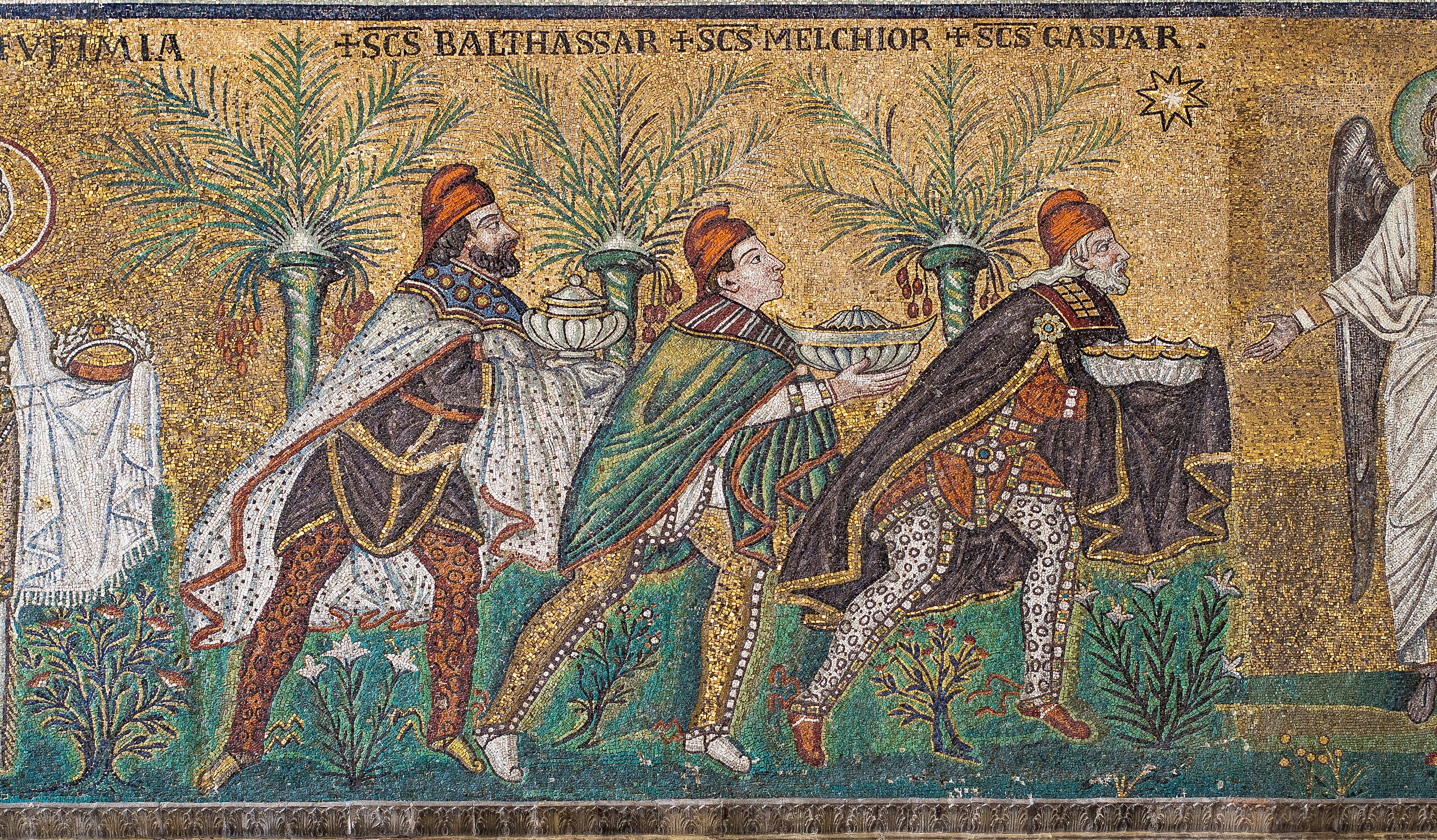
“The Magi” Mosaic, Sant’Apollinare Nuovo, Ravenna, Italy, 6th century

The cover image on today’s service bulletin is of a mosaic in the Basilica of Sant’Apollinare Nuovo in Ravenna. It probably dates to the 6th century and the reason I love it is because it shows how early Christians had already developed considerable speculation about the beloved figures in today’s gospel reading, the magi. For here we see that the tradition had fixed on the idea that there were three, although the only mention of that number is with regard to the gifts: gold, frankincense, and myrrh. In addition, they already have names attached to them: Balthasar, Melchior, and Caspar. It would be later in the Middle Ages, part of the general exoticizing of the figures, that one of them would usually be depicted as black. Other examples of such exoticizing can be seen in the figures in our creche. The elephant, for example is a wonderful symbol of the strange and foreign east, from which we are told the magi came.

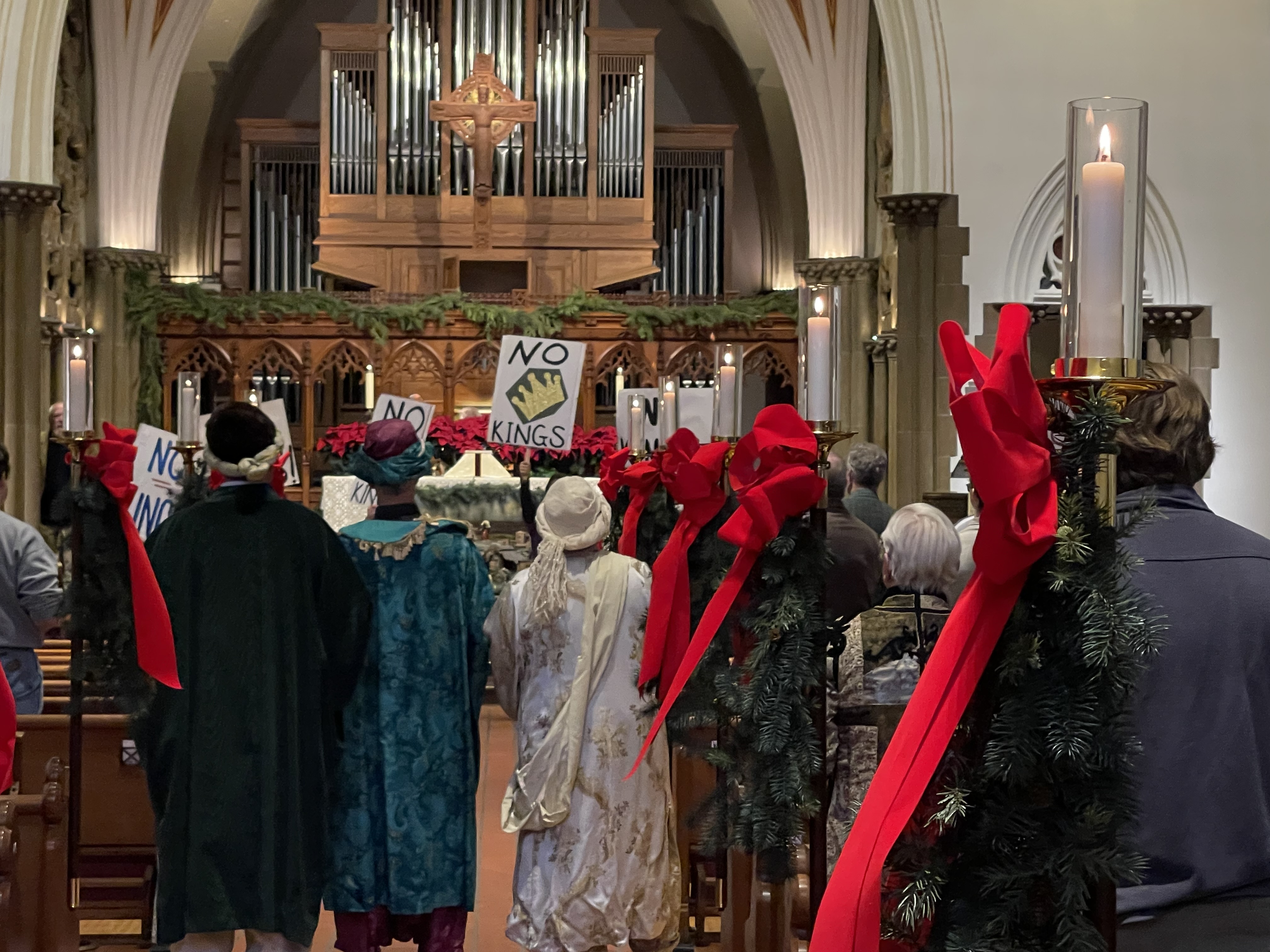
And while our skit insisted “No Kings” and in my sermon last Sunday I pointed out the presence of two kings in the story—Herod and Jesus, and noted that in Matthew’s gospel Jesus is referred to as “King of the Jews” only here in the nativity story and at the end in his trial and crucifixion. The elevation of the magi to “kings” is also a fairly early development in Christian devotion though there’s no scriptural warrant for it.

My point is not to debunk the story. In fact, I think these developments reflect deep Christian piety and devotion that can be instructive to us as well. At the same time, it’s worth noting the ways in which such images have reflected and continued to shape our prejudices. It’s a lovely, familiar story but it also packs a wallop. 

Perhaps especially today as we experience it while our nation undertakes yet another foreign adventure, initiating regime change for illegitimate reasons and flouting international law and human rights. Not content with blowing boats out of the water, our administration decided to intervene in another nation, and as has happened so often in the past, has little idea what to do now that it has removed the political leader. A region that has seen its share of ruthless dictators and petty tyrants, is now threatened with instability.

As if destabilizing one nation isn’t enough, spokespeople for the administration are sabre-rattling about regime change elsewhere as well and hinting at territorial expansion: Greenland, Canada. Those of us who have imagined our nation to be a force for peace, human rights, and democracy are watching in real time as those values are upended both here and globally. In a year when we observe the 250th anniversary of the Declaration of Independence, the gap between our ideals and the reality in which we live seems wider than ever.

Moreover, that so much of this is carried out in the name of Christian nationalism poses yet another challenge. Propaganda from the Department of Homeland Security and other federal agencies advocate for an ethnic cleansing of the nation in the name of Christ and whiteness. Of course, we’ve seen this before with language and imagery of crusade being invoked in the runup to and during the Iraq War of 2003. 

With all this as backdrop, with all this swirling through our minds on this day, we may be tempted to placate ourselves by ignoring it all and losing ourselves in a familiar story and well-known hymns. We may want a simple story that hearkens back to our childhoods, and allows us to linger in awe and worship at the creche on this 10th day of Christmas even as the attention of the rest of our culture is elsewhere, on military adventurism, or more likely, football.

But even here, in this story, there are ominous notes. We are introduced to Herod, the client ruler of Rome, 

Although a convert to Judaism, Herod was hated by most Jews as the king of Judea, in part because they thought he was Jew in name only and in part because of his pro-Roman leanings. He became king by submitting to Roman authority. He lavished his territory with building projects, including a renovation and expansion of the temple in Jerusalem. Known for his ruthlessness, Herod executed at least three of his sons for conspiring against him. The slaughter of the innocents, which Matthew recounts immediately after his story of the magi is not recorded in any history of the period, but is entirely consistent with Herod’s personality.

The exchange between the magi and Herod borders on the absurd. Who in their right mind would approach a king who has killed his own sons because of their designs on his throne, and ask him where the next “King of the Jews” would be born? But Matthew uses it to heighten the contrast between the reign of Rome through Herod, and the reign of Jesus Christ. The same is echoed at the end of Matthew’s gospel, when Pilate sarcastically asks Jesus, “Are you the King of the Jews?”

There is irony here for Matthew as well. Part of his point in telling the story of the magi is to emphasize that these gentiles, these foreigners, can recognize Jesus’ divinity, and worship him, even if his own people cannot. 

And that may be the message for us as well. We are distracted, angry, disheartened, fearful. We have seen so many succumb to the temptations of wealth and power, perverting the gospel to serve their own ends and to serve evil. The tyrants of this world, whether political or economic seek our submission and silence, demand we bow before them. 

But across the millennia, this familiar story offers us a different path, like the one taken by the magi on their return home, a path that leads us away from the centers of power and the seduction of wealth, and back to Bethlehem, to the creche, where the Christ child lays. 

It is a path that will lead also to the cross, where Jesus offers himself, a sacrifice of love in a world of hate. It is a difficult road, full of danger but it is the journey to which we are called as followers of Jesus, to listen to his voice, to hear his gospel of love, and to share the good news in a broken and hurting world, offering healing to those who are suffering and hope to those in despair. As we kneel at the creche with the magi in adoration and worship, may we gain the courage and strength for the journey ahead, and may the light and love of Christ fill our hearts.

Holy Innocents: A Sermon for the First Sunday after Christmas, 2025

December 28, 2025
Christmas I

Merry Christmas! While the world and even most Christians, at least in the US have turned their backs on Christmas, are putting decorations away, and the like, for us, we are still in Christmastide. It’s the fourth day of Christmas—four calling birds, remember? It is also the First Sunday after Christmas but we’re taking some liberties with the lectionary today. 

In the Episcopal Church, the gospel appointed for the First Sunday after Christmas is always John 1:1-18. That’s something of a challenge because the gospel for Christmas Day is virtually the same reading: John 1:1-14. As I told the congregation on Christmas, I’ve preached on that text every Christmas Day since becoming a priest, and a couple before that, and on many of the following Sundays as well. It’s one of my favorite gospels of all. But if you want to hear a sermon on that text from me, you’re going to have to wait until next Christmas, or check out my website, where I post many of my sermons.

Instead, we are observing the Feast of the Holy Innocents today, which in the liturgical calendar falls on December 28, but because today is a Sunday, the observance would normally take place on Monday. We’re doing that at the request of our Stonecatchers group who has an activity planned later in the day, and thought this gospel story spoke especially well to the moment we are in.

There’s a historical connection with Grace as well. Our oldest stained glass window, the Vilas Window, was dedicated on the Feast of the Holy Innocents in 1887, commemorating Esther Vilas’s deceased husband and five of her children. That too speaks to our moment, for it’s a reminder that before the rise of modern medicine, many children died of childhood diseases that had been eradicated, or nearly so, thanks to vaccines.

Still, on this the fourth day of Christmas we should still be in full celebration mode. There are still Christmas cookies to be eaten, at least at our house; we’re looking ahead to New Year’s and another round of celebration, and the Packers have made it into the playoffs, although with three straight losses and all those injuries, it’s not looking good for them.

For all the joy and celebration of Christmas, and the nativity stories, in both versions related by the gospels of Matthew and Luke, there are ominous notes. That’s especially true of Matthew’s story in which Herod plays a prominent role. While this particular incident is not recorded in extra-biblical sources, we do know from the Jewish historian Josephus that Herod was a ruthless, murderous tyrant, and such an action would not have been out of character.

Still, the story is upsetting on several levels. First of all, to hear it now is to wreak havoc with the chronology of Christmas—it comes after the visit of the magi, which we will commemorate on later, on January 6, the feast of the Epiphany. And the utter evil of it—to kill all children, not just males, under the age of two. Such indiscriminate violence is more in keeping with our contemporary age, familiar as we are with genocide, carpet bombing, and school shootings.

Matthew isn’t content just to tell the story, he places it in the larger context of Israel’s salvation history, beginning with Joseph himself, who like his namesake in Genesis, is a dreamer of dreams. The flight to Egypt recalls the resettlement of Jacob and his family from the promised land of Canaan to Egypt in a time of famine, and the massacre of the holy innocents itself is an echo of Pharaoh’s decree that all the Hebrew baby boys should be killed.

It’s hard not to see another parallel to our own day. The image of the Holy Family desperately fleeing an evil ruler to save their lives, calls to mind all those who have fled evil regimes and desperate circumstances. We have heard horrific stories over the last year of refugees, asylum seekers, and others who have been forced to return to places where their lives would be placed in danger, families ripped apart.

While it may be overly facile to draw an exact parallel between the fate of the Holy Family as related in this story and the plight of refugees, it should give us pause to think. One of the realities of our day is the way in which many have dehumanized others unlike themselves, deriding them as subhuman as recent photos of tattooed refugees in incarceration (they’re all criminals); dismissing them as “illegals” or fear-mongering about their eating habits. To draw a connection between the Holy Family on the flight to Egypt and the plight of refugees and asylum seekers is to challenge all of us to see these vulnerable people as fellow humans, deserving respect and humane treatment.

So too with the massacre of the innocents. As one commentator wrote, “Tradition makes them the Holy Innocents, a remarkable kind of saint who never knew Jesus, but who were his companions and proxies in death.”

One of the interesting elements of the story is the juxtaposition of different understandings of kingship. On the one hand, there’s Herod a ruthless tyrant who for all his power rules only at the whim of the Roman Empire. In the background, there’s also Pharaoh, equally ruthless, like Herod, capricious and yet fearful. 

And then there’s Jesus, identified in this story by the magi as “King of the Jews”—a title mentioned only here in the Gospel of Matthew, and at the end of the gospel, when Jesus is labeled as “King of the Jews” first by Pilate, then in the inscription on the cross. Herod, a king who murders his subjects; Jesus, the king who identifies with his people, is crucified, suffering alongside and for them.

Later today, members of Grace and other Christians from throughout Madison will gather to bear witness to suffering that is taking place in our community and across our land. As you know one of the groups targeted by the current administration and their supporters are members of the trans community, beloved children of God. The Stonecatchers movement seeks to protect vulnerable communities in this time of division and hatred, and through their worship and action today, hope to express their solidarity with some of the most vulnerable people in society.

Many of us struggle with how to respond appropriately and effectively, offering a Christian witness of love and inclusiveness when weaponized hatred and all the power of the state are arrayed against the vulnerable. In many places, clergy and faithful people are taking a stand against ICE activity, speaking out against hatred and state violence. 

We may not know how to respond; we may be fearful ourselves, but this powerful, violent story reminds us that the Jesus we follow is a victim of such state violence, both in his family’s forced flight to Egypt and in his crucifixion, that Jesus stands on the side of and with the vulnerable and the oppressed, and that he calls us to join him in that witness.

And as the collect for the day reminds us, ultimately, it’s not in our hands but in God’s: “Receive, we pray, into the arms of your mercy all innocent victims; and by your great might frustrate the designs of evil tyrants and establish your rule of justice, love, and peace; through Jesus Christ our Lord.

Amen.

The Word became flesh: A Sermon for Christmas Day, 2025

“And the Word became flesh and lived among us, and we have seen his glory.”

I’ve been at this preaching thing for some twenty years, and for all of those years, except during the lockdown, I have preached on Christmas Day. It hasn’t become any easier over those years. I’ll be honest, I’m twenty years older than I was a started out as a priest, and my body feels that every day, but especially today. I got home after midnight last night, and the alarm woke me at 6 this morning.

There’s another reason it doesn’t get easier. After twenty times preaching on this gospel text, actually more than that, because it’s also the gospel appointed for the 1st Sunday after Christmas, you might think it difficult to come up with something new to say. Well, you’re right, but at the same time, who needs something new when you’ve got the majestic prologue to John’s gospel: In the beginning was the Word and the Word was with God, and the Word was God.

I’ve been thinking a lot about this text as it relates to our cultural moment. We live in a post-truth world. Politicians lie brazenly and are not called on it. Our social media feeds are filled with fake videos produced by AI; having lost our moorings in reality, we are at the whim of the loudest shouters, the most spectacular influencers; the billionaires with infinite wealth who can spread falsehoods and sway millions. We can create AI friends in our loneliness and despair.

And it is coming into the institutional church as well. You’ve probably all heard of the various chatbots used by churches and denominations—perhaps you’ve even found yourself using them. I was appalled this past summer when I saw an ad for a webinar sponsored by a major Episcopal entity that promised to show us how we might make use of AI, in our communications, outreach, and evangelism. I know there are many clergy who use AI in crafting their sermons.

But this: in the beginning was the Word and the Word was with God and the Word was God. Our Christian faith proclaims that there is a deep relationship between our thinking, our words, and the Divine Word. No matter how inadequate our words may be to express our faith, to convey the truth of our faith, when we use them, we are touching in some way, the Truth of the Word. We stretch ourselves to understand, comprehend, we stretch ourselves as we try to communicate our faith with others, and when we do, we are touching the Divine Word.

“The Word became flesh and lived among us.” The incarnation is a great mystery of our faith, something that we should ponder and treasure in our hearts, something we should puzzle over, ponder. More than that. The Word connects us with God because our words, our thoughts are attempts to approach and understand the Word. By thinking, reflecting, struggling to understand the meaning of the Word become flesh, there’s a way in which our thinking itself makes Christ present in our minds and in our lives.

You may find all this very abstract. It is, but John doesn’t stop there. He goes on. The word became flesh and lived among us. 

With this verse, John brings us back to Bethlehem, to the reality of the incarnation. Literally the Greek reads, “and the word became flesh and tabernacled among us.” While John likely wants us to think of the tabernacle that was the symbol of God’s presence to the Israelites in the wilderness, it’s also the case that we are to think of Christ being among us, “living among us” in a temporary, make-shift way, like a tent. That is to say, the word took on frail human flesh to be like us. 

This paradox, this mystery is quite beyond comprehension. The Word taking human flesh. St. Augustine captures the paradox in one of his sermons on this text for Christmas:

“He so loved us that for our sake He was made man in time, through Whom all times were made; was in the world less in years than His servants, though older than the world itself in His eternity; was made man, Who made man; was created of a mother, whom He created; was carried by hands which He formed; nursed at the breasts which He had filled; cried in the manger in wordless infancy, He the Word without Whom all human eloquence is mute.” — St. Augustine, Sermon 188

John goes a step further. For John, this infant, this tiny human creature, incapable of speech, vulnerable, utterly dependent on others for life itself, this infant reveals God’s glory to us.

So we are back in Bethlehem, back in the confusing paradox that God became incarnate in a very ordinary way, in the poorest of circumstances, in the weakest of all human forms, a baby. And it is in that paradox, that we see God’s glory. For John, it is the same paradox as the cross, which he almost always refers to as the glorification of Christ. What he is telling us is that in these moments of weakness, we see God’s majesty and power.

To see and know Christ, the Word, in the babe in a manger, is to see and know God’s glory. To see and know Christ in the cross, is to see and know God’s glory. To see and know Christ, to taste Christ in the bread and wine of the Eucharistic feast, is to see and know God’s glory. 

May we experience, may we see and know the glory of God today, in our lives, and in the world around us, in the Christ made flesh in a manger and as we kneel at the altar. May we know and believe the mystery of our faith, the mystery of the Incarnation, the mystery of God’s love for us, today at Christmas, and throughout our lives. Amen.

Things earthly and heavenly gathered into one: A Sermon for Christmas Eve, 2025

December 24, 2025
Christmas Eve
2025

On Christmas Eve, I always feel the chasm between the way things are and the way they ought to be especially acutely. There’s the beauty and brightness of our church, our worship, and our music; the joy of our celebration, our happy faces, excited children. And then outside, there’s the darkness of night, the realities of a world, suffering people, breaking hearts, hunger, homelessness, violence and evil.

Those differences have always been present, but in the past decade or so, I’ve been feeling that disjuncture more acutely, and it seems that gap between the world’s suffering and our celebration grows ever wider.

We live in tumultuous, chaotic times, as we watch our society collapsing, behavioral norms vanishing, as we witness the attacks on civility, on science, and learning, as institutions we held dear are under attack. We are fearful, anxious, and we know that others around us are even more frightened as families are ripped apart and immigrants deported. We avert our attention from the news because we can’t bear knowing all the details, whether it’s suffering in Gaza, war in Ukraine, or attacks on our healthcare system that put all our lives in danger.

This chaos has even come to Christianity as it is experienced and practiced in the United States. The rise of Christian nationalism has transformed the figure of Christ from the Prince of Peace to a Warrior, as it rejects his message of love of neighbor and enemy, and his embrace of the outcast, the vulnerable, and the foreigner.

It may be that you are tuning me out right now, because you came here to get away from all of that, to have a little peace and quiet, to sing familiar carols, to be reassured of well, normalcy, in these strange and unsettling times. We want to keep the barbarians, or our deepest fears, outside the gates, and activate security systems in our homes and our psyches to keep the chaos at bay.

But there are similar contradictions at the heart of the Christmas story, at the heart of the Christian faith. Think about Luke’s story of the birth of Jesus. On the one hand, he places his narrative squarely in the context of the Roman Empire: “In those days a decree went out from Emperor Augustus that all the world should be registered. This was the first registration and was taken while Quirinius was governor of Syria.” We see the reach of empire—a capricious, violent ruler demanding that the population be counted, why, so imperial domination could extend its way to the furthest reaches of the population. Rome, the eternal city, the city to which all roads led, the greatest power the world had ever seen.

On the other hand, and the contrast couldn’t be greater, another city is mentioned, the city of David, Bethlehem,  a tiny village far from the centers of power. But with the mention of David, an allusion to a long-ago monarchy that was conquered, a subject people, and a far away history.

And the people: the emperor, the governor, men in power, men of power, and Joseph, a powerless nobody, Mary, a pregnant, vulnerable teen. Their places: palaces, sumptuous furnishings and meals, many attendants; the other, Joseph and his family at a manger, in a cave? Because there was no room in the inn. Even more: The emperor would be announced throughout the empire as Savior, bringing peace; that’s the good news, the euangelion, the gospel. But the angels use the same language: a savior is born.

These contrasts like other contrasts of the season: light and darkness; the contrast between the emperor who reigns in Rome, and the king who is born in Bethlehem; the empire that rules by violence and intimidation; and the reign of God that ushers in peace and justice.  

Such dichotomies are present throughout Luke’s story. Think of the Magnificat, Mary’s great song of praise:

He has shown the strength of his arm, *
he has scattered the proud in their conceit.

He has cast down the mighty from their thrones, *
and has lifted up the lowly.

He has filled the hungry with good things, *
and the rich he has sent away empty.

Such divisions, between the weak and the powerful; rich and power are divisions we know too well today, as the differences between the haves and have nots grow wider, billionaires increase their wealth while people go hungry and unhoused around us. These divisions which we know so well are used to divide and demonize the other.

But it’s not just in the world around us where we see such stark differences. We see them in ourselves, as well. We know the person we want to be, and the person we so often are; the differences between our hopes and aspirations and the realities of our lives; the differences between what we should do, and what we actually do, all the ways we fall short and disappoint ourselves and the ones we love. 

Our tendency, when it comes to our own lives, and the dichotomies in the world in which we live, is to overlook or try to ignore those differences, to hide them from ourselves, to insulate ourselves from the suffering and pain in our hearts and the world around us. We may even want to hide them from Christmas, in our efforts to have the perfect celebration in an imperfect world.

But that’s precisely the sort of misguided exercise we humans tend to attempt. In fact, what we are celebrating at Christmas is the breaking down of those barriers: God becoming human, the word becoming flesh. In the words of a blessing often used at Christmas: “Christ, who by his incarnation gathered into one things earthly and heavenly…”

Or St. Paul: “In Christ, God was reconciling the world to Godself”

Christ comes into the chaos of the world, into its suffering and pain; takes on that suffering and pain, redeeming it, and us. In Christ, we receive adoption through grace, grafted onto his body. In Christ, all things are made new.

We see that taking place as Christ takes on human flesh, as a baby, in all the vulnerability and weakness that symbolizes, in the dependence of a baby on the love of parents and others. 

We will go from this place out into a cold and dark world, the light of our candles extinguished, but the hope in our hearts rekindled. The world will not have changed. There is still suffering, pain, despair; in the dark places of the world, and in the dark places of our heart.

But the coming of Christ brings rays of hope and love into that darkness for the light, the light of Christ, shines in the darkness and the darkness cannot overcome it. May the light of Christ, may the light of Christmas, shine in the darkness of the world, the darkness of our despair and fill us with his light and grace.

God with us: A Sermon for Advent 4A, 2025

You may have seen the stories over the last couple of weeks about the nativity scenes set up by various churches across the country that protest the actions of ICE. At a Roman Catholic Church in Dedham, Mass, the figure of the baby Jesus was removed and replaced with a sign “ICE was here.” Apparently the Archbishop protested and demanded it be removed, but the last I heard, it was still there. Similar scenes have been displayed in Chicago and Charlotte, where ICE activity has been especially pronounced.

We may find this sort of political protest unseemly or offensive, but it’s hardly new. There were similar displays during the first Trump administration and two years ago as Israel was reducing Gaza to rubble. Our tendency, our temptation is to want our Christmas celebrations to be escapes from the realities of the world and our lives, but the fact of the matter is that the story of Jesus’ birth is the story of God breaking into the world in all of its messiness and pain.

“Now the birth of Jesus the Messiah took place in this way.”

Today, on this fourth Sunday of Advent, we hear the story of the birth of Jesus as related by the gospel of Matthew. And I’ll bet that as you listened, you may have found it a bit strange, perhaps even unfamiliar. For it’s a very different story than the familiar one from Luke that we hear on Christmas Eve, with Bethlehem, the manger, shepherds, swaddling clothes, and all of that.

Matthew’s story seems to focus on Joseph. Mary and her pregnancy seem to be problems that need solving, and the birth itself is recounted in the sparest of terms. The focus on Joseph is odd in a way, if you think about it. It’s even odder when you put the reading we just heard back into the context of Matthew’s gospel, for these verses appear after a lengthy genealogy that relates Joseph’s ancestry back to Abraham. Thereby Matthew links Joseph not just to the ancient patriarchs and matriarchs—Abraham and Sarah, Isaac and Rebecca, Jacob and Rachel, but also to the Kings—David and Solomon. 

What’s odd about this is that of course Joseph is not biologically the father of Jesus.

Matthew gives us a genealogy for Jesus, and it’s worth considering why he thought it was appropriate, or important, to do so. There’s even something more interesting in all of this, because the words he uses to introduce the genealogy at the very beginning of his gospel, and the first words we heard in today’s reading, are very similar—both make use of the Greek word genesis—and it’s likely that Matthew intends his reader to think of the first book of the Hebrew Bible, Genesis. 

So it’s curious, isn’t it, that Matthew, after providing all of that background to the birth of Jesus, taking the time to carefully construct a genealogy that links Joseph back to Abraham, then tells the story of what basically constitutes an illegitimate birth.

The story that we heard is familiar. Joseph and Mary are engaged, or to use the traditional language, they are betrothed. It’s not just that he’s given her a ring, and they’ve begun to plan for the big day, scheduled the date and the venue, hired the caterer and the like. No, in Jewish law, the betrothal meant they were legally married, even though the marriage had not been consummated and they were not living together.

Because they were legally married, Mary’s pregnancy was not just an inconvenience. It indicated to Joseph that she had been unfaithful to him. Legally, because, as the text says, Joseph was a righteous man (in other words, he kept the law), he was obligated to divorce her publicly—something that might result in her execution for adultery. But Matthew tells us that he wanted to spare her the indignity, and perhaps himself as well, and divorce her privately.

So he’s got a huge problem on his hands, what to do. It’s likely, though Matthew doesn’t tell us, that Mary is feeling considerable anxiety and fear as well. After all, it’s in Luke’s version of the nativity that Mary is told by an angel that her pregnancy is miraculous, that she’s carrying the Son of God. 

In Matthew’s story, the angel comes to Joseph to explain things to him. He does as he’s told, and almost as an afterthought, Matthew tells us that the child is born and Joseph names him Jesus. Again, to use contemporary language, Joseph adopts Jesus as his son.

Christmas, which the songs tells is the “most wonderful time of the year,” can also be a time of great sadness and struggle. We are presented with images of the perfect family or the perfect holiday celebration but so often, our own experiences of Christmas are very different. We live in a messy world, we lead messy lives. Our families can be complicated; there can be ruptures or conflicts with family members; there are all the complications of modern family life, divorce and remarriage, blended families. We want everything to be perfect, just so, and so often the reality is very different.

I think there’s something reassuring for us in the twenty-first century in the way Matthew tells this story. He wants everything to be perfect, too. He fashions a genealogy that links Joseph to Abraham, carefully constructing 14 generations from Abraham to David and 14 generations from David to the exile, 14 generations from the exile to Joseph. To put it language from American history, it would be as if Joseph were descended from the Daughters of the Revolution and the descendants of the Mayflower. But it’s not just that the link from Joseph to Jesus is tenuous—it’s that in the midst of that genealogy are prostitutes like Rahab, and victims of rape and incest like Tamar, foreigners like Ruth.

And in the embarrassment of Mary’s unwed pregnancy, in the embarrassment of that genealogy, is an important lesson for us today. Just as we want our celebrations to be perfect, we assume that there’s something wrong with us if things don’t live up to those expectations and we wonder whether in the midst of our struggles, we can hope for God to come to us, for God to be with us.

The story of the birth of Jesus as told by Matthew is a reminder to us that God didn’t choose the wealthy, or powerful, or the Norman Rockwell family in the Norman Rockwell New England town. God came to Mary and Joseph, to a peasant woman and her fiancé, in the outmost corner of the Roman Empire. God came to people in the midst of enormous struggle and great heartache. 

The message of this story is that God is with us—here and now—no matter what our situation is, no matter what our lives are like, no matter what struggles we have, or worries, no matter what shame or guilt we might be experiencing. God comes to us. God is with us. That’s the point of this story. That’s the point of Christmas. God is with us. Here. Now. Emmanuel.  God with us. Thanks be to God.

Stir up thy power, O Lord: A sermon for Advent 3A, 2025

Advent 3A

December 14, 2025

Stir up thy power, O God, and with great might come among us…

The collects for Advent are beautiful and powerful, none more so than this one which provided the name this Sunday is known as” Stirrup Sunday.” It is a profoundly Advent prayer, bidding God to come to us in the midst of the suffering and evil in the world, which we experience so profoundly. With all the suffering that is taking place, our hearts breaking and broken, we may feel that we cannot bear anything else. But then…

I went to bed last night amid the news of the mass shooting at Brown University. This morning, as I was looking over my sermon again, I heard about the mass shooting targeting a Jewish Chanukah celebration at Bondi Beach in Sidney Australia. How do we maintain our faith that God is coming among is in the presence of such tragedy, such evil? Our gospel reading seems especially appropriate for us today.

Last week we saw John the Baptizer at the height of his power and career. Crowds were coming to see him and to be baptized by him. Even the movers and shakers were coming—the Pharisees and the Sadducees. How do think he was feeling as he saw the response to his preaching, the adoring crowds and the changed lives. As evidence of his power, we hear him attacking the religious insiders with language of great drama and violence.

Now, some weeks or months have passed and John is in a very different position. Herod had arrested him because John had criticized him for marrying Herodias, his brother Phillip’s wife. Another important point to note is that in the synoptic gospels of Matthew, Mark, and Luke, Jesus begins his public ministry only after John is arrested. In other words, John doesn’t actually see Jesus’ preaching and healing ministry in action. He only hears about it second hand. 

John is in prison, waiting. In the Roman world, prison was a place of waiting, not of punishment. Prisoners were waiting to find out what the judgment would be, whether they would be found innocent or guilty, and what their punishment would be. Execution, sentenced to the galleys or the mines? John was waiting.

John had been waiting for a long time, not to find out his fate. He, like Israel, had been waiting for the one who was to come; he was waiting for deliverance. And so, from prison, he asks that question, “Are you the one who is to come, or are we to wait for another?”

As we saw in last week’s gospel, John was looking forward to a great reckoning; the day when God’s justice would come down to vindicate the righteous and punish the wicked. John had prophesied, “Even now the ax is  lying at the root of the tree; every tree therefore that does not bear good fruit is cut down and thrown into the fire.”

John was now in prison, hardly evidence that God was making things right. And Jesus, the one whom John had baptized, the one in whom he had placed his hopes, had continued John’s preaching. He, like John, was proclaiming the coming of God’s reign. But there seemed to be no signs of its arrival.

So, John, lying in prison, wonders. He wondered whether everything he had been about had meant anything; whether his preaching had been worth it. So he sent two of his followers to ask the question. It’s an obvious question, but still it’s a very interesting and important one. And it is a profoundly “Advent” question. Advent is a time of already but not yet; it is a time when we recognize Christ’s presence among us, Christ’s having come among us as a human. But at the same time, we are looking ahead to that final reckoning. Like John, we are looking ahead for that time when God makes all things new; when God’s justice rolls down like water, and God’s righteousness like an ever-flowing stream.

John’s disciples asked Jesus the question, “Are you the one who is to come or are we to wait for another?” 

Jesus’ reply is not a simple and unambiguous affirmative. Instead, he instructs John’s disciples to tell him what they have seen, “the blind receive their sight, the lame walk, the lepers are cleansed, the deaf hear, the dead are raised, and the poor have good news brought to them.”

We hear this passage and we think it’s all so obvious and we may even wonder how John the Baptist could have had any question about who Jesus was.

But think about it a moment. Think about all of the suffering in the area where Jesus was preaching and healing. He may have performed some healings, but there were many other people who continued to suffer and the oppressive yoke of Roman occupation was as harsh as ever. Did Jesus’ answer convince John’s disciples? Did it convince John?

Like John, we are living in a time of already but not yet. We believe and proclaim that Christ has come into the world; that Christ has ushered in something quite new; that his death and resurrection have changed everything.

At the same time, we continue to see the suffering and injustice around us. Many of us experience great suffering and pain in our own lives. It may so overwhelm us that we despair.

Jesus’ answer to John’s disciples is his answer to us. In the midst of the world’s suffering, in the midst of our own pain, he challenges us to see signs of his coming; to look for signs of God’s coming reign; signs of his healing power. Those signs may be faint; they may be overwhelmed by the bright lights and glare of the world.

Like John, we want to see clear evidence; we want to see God coming in glory, destroying evil, beating down the devil. We want to see the carnage and a complete and total victory.

Instead, we are pointed toward this. A few people are healed; a few hear the good news and are transformed. God’s reign breaks in, tentatively, quietly, almost unnoticeably. So we have to pay attention. 

There are signs, but we need eyes that will see them; ears that will hear them. I invite you to look for those signs, to imagine what such signs might be in our world today. In the midst of the suffering in the world, in the midst of all of our troubles, where do we see Christ’s healing power? Where do we see God’s justice rolling down? Where do we see God’s reign breaking in and transforming lives and the world?

The Magnificat, Mary’s song, gives us another perspective on this, and another perspective on time. She sings:

My soul proclaims the greatness of the Lord,

my spirit rejoices in God my Savior; 

He has cast down the mighty from their thrones, *
and has lifted up the lowly.

He has filled the hungry with good things, *
and the rich he has sent away empty
.

Mary sings about God’s mighty acts, but she is not looking into the future, hoping for God’s making all things right. She sings in the past tense, these are things God has already done; this is God making things right, bringing justice and equity to the world.

Look for those signs, in the world, in the lives around you. Become those signs, to the world, to the lives you encounter. God is here among us, healing us and the world. Christ will come again to make all things new. May we rejoice to see his coming; and may we see the signs of his coming in our faith and in our actions.

Advent 1A

November 30, 2025

Time is a funny thing. There are times, as when we are in the middle of something exciting, when it seems like it passes in an instant. And then there are those times when we’re sitting in a waiting room and time seems to pass slowly, especially when the doctor is late for our appointment. Years ago, I would schedule my doctor’s appointments for first thing in the morning, so when I had to wait a half-hour for him to finally show up, I could let my outrage boil over, knowing the delay wasn’t due to them dealing with another patient, but rather they were just late getting into the office. Needless to say, I eventually tired of this and found a new primary care physician.

There’s also the way in which time can seem to pass in an instant. One of the realities I’ve had to deal with as I have been rector of Grace for now more than 16 years is the disorienting way in which time passes. I’ll find myself recalling some event, or someone, thinking that it occurred a few years ago, and suddenly realize that it’s been more than a decade. It’s particularly disconcerting to encounter young people who I baptized when they were infants and are now graduating high school.

The season of Advent challenges us to reflect on the meaning of, as well as our experience of, time. In the first place, it is the beginning of the liturgical year; for Christians who follow the liturgical calendar, the first Sunday of Advent is New Year’s Day.

While thinking about today as New Year’s Day would seem to help us place ourselves in time, in fact, we find it does something else entirely. It is profoundly disorienting to our sense of time, and our sense of our place in time. Advent encourages us to look forward—to Christmas and the birth of our Savior, but as it does so, it also prompts us to look backwards, to those events that took place two millennia ago in Bethlehem.

Simultaneously, though, Advent propels us forward not to December 25 and the rituals and stories of Christmas, but to the end of time itself, to the second coming. 

This disorientation and reorientation is fundamental to the season of Advent; and it is fundamental to the Christian faith.

One way in which we are being reoriented is through the changes in the lectionary. Each of the three years of the lectionary cycle, we focus on one of the synoptic gospels. This past year it was Luke. This year, it will be Matthew. This focus allows us to spend some time getting to know the gospel writer and the context and community within which they were writing. In Matthew’s case, as we shall see, there is a particular interest in laying out the similarities and distinctions of the Jesus movement with first-century Palestinian Judaism. At the same time, Matthew, like Luke, draws on the gospel of Mark for much of its chronological structure and many of its stories about Jesus.

Today’s gospel is one of those places where Mark’s influence is particularly evident. We have a section of what scholars call the “little apocalypse—” a sermon of Jesus given in the last week of his life, while he is teaching in and around the temple. We actually heard Luke’s version of some of the same material in recent weeks.

When I was a kid, for some reason, one year one of the local churches was given the opportunity to show Christian-themed movies in the schools. One of those films, I don’t know the title anymore, was about the second coming. I remember one scene especially. A man was in his bathroom shaving, and suddenly he was gone. It was a movie that aimed to depict what is called the rapture, an idea that emerged in nineteenth century Evangelicalism and captured the fascination of many—the idea that at the second coming, the faithful would be transported to heaven while the rest of humanity remained on earth to face the consequences.

One of the proof texts for the rapture is in this passage: “Then two will be in the field; one will be taken and one will be left. Two women will be grinding meal together; one will be taken and one will be left.”

It’s a frightening image, and especially as the idea has played out in modern Christianity, it has captured, and traumatized many. But it’s a misreading of scripture, and a profound perversion of the notion of the second coming. Contrast that fear-mongering with Isaiah’s vision from the first lesson:

they shall beat their swords into ploughshares,
and their spears into pruning-hooks;

nation shall not lift up sword against nation,
neither shall they learn war any more.

This vision, cast in the ninth century bce, continues to inspire. The idea of an age of peace, of justice and equity, when God reigns is a powerful image, reminding us that even as we experience all the ways in which our world and our lives fall short of that vision, our faith continues to express itself by hoping that God will make all things right.

But it will happen in God’s time, not ours. One lesson that Advent teaches is that even as we look ahead to Christ’s coming at Christmas, as well as Christ’s second coming, the day and the hour are not ours to set. God’s time spans past, present, and future. Indeed, God is outside of time.

Yet as the reading from St. Paul’s letter to Romans reminds us, our waiting, our experience of time is not flat and meaningless. “Salvation is nearer to us now than when we were first believers; the night is far gone, the day is near.”

Both the gospel and the reading from Romans point to the ways in which early followers of Jesus were disoriented in time. There’s a great deal of evidence that those early Christians expected Jesus’ imminent return. When he seemed to tarry, they began to wonder whether their hopes were real, and if there hopes of an imminent second coming were not going to be realized, what would that mean for their faith in Christ?

Jesus warns his listeners, “But about that day and hour no one knows, neither the angels of heaven, nor the Son, but only the Father.”

In a way, Jesus’ words are doing to his listeners just what Advent is doing to us. He is trying to reorient them toward a new understanding of time, to change their expectations and experiences of it. So too does Advent do this to us. We are betwixt and between. Even as the circles of time continue through the years, Advent breaks in upon us and presents us with a different sense, or senses of time. As we look ahead for four weeks to Christmas, we are looking even further beyond to Christ’s second advent and those two markers remind us that ultimately, we are not in our time, or time of our making, but in God’s time. And in God’s time, God will make all things new, and we will beat our swords into plowshares and our spears into pruning hooks. And we will study war no more.

Thanks be to God.

Rector’s Annual Report, 2025

November 16, 2025

As I reflect on the past year, I realize the extent to which our lives have been dominated by events in the world and by construction—both our own new roof and plans for the restoration of the gardens. There is also all of the construction that is taking place on North Carroll St.—both the new Wisconsin History Center and the conversion of the Churchill building to a boutique hotel. In fact, I wrote much of this report at home because of the distracting noise outside my office windows.

We should all take great satisfaction in the project that has consumed so much of our time energy and financial resources over the last few years—preparing for and accomplishing the replacement of the slate roof on our nave. As I have often said, our forebears at Grace have bequeathed a great legacy to us in this beautiful and historic building and what we have done this year is ensure that we will be passing that legacy on to future generations, future members of Grace as well as the wider community that appreciates its beauty and its sacred presence on Capitol Square.

There are many people to thank for their contributions to this project, not just the many donors, but those who worked so hard over the years to see it to fruition: above all Roof Committee Chair Deb Anken-Dyer, Project Manager Fred Groth, members of the Roof Committee: Suzy Buenger, John Wood, Amy Robinson, Joe Bartol, Jane Hamblen. Similarly, our Fundraising Committee deserves thanks: Mark Hope, chair, Suzy Buenger, Amy Robinson, James Waldo, and Jane Hamblen.

While the roof is complete, there will be more construction in the coming year. As you have heard, while making masonry repairs related to the roof, we discovered that the wood trim around the stained glass windows has experienced significant deterioration. We will be moving forward in the spring to repair them and once that work is complete, the gardens will be restored. Fortunately, we have received a significant grant toward the garden restorations, and while landscaping cannot be included in the Historic Tax Credits, the window repairs can be.

I would like to express my deepest gratitude to the lay leadership of the parish—…

And the staff. We are blessed to be served by amazing people in the office. Kristen and Erin are a joy to work with; good-natured, incredibly competent, going far above and beyond their position descriptions and their normal working hours to make sure things run smoothly and problems solved. And, when necessary, they will transport the rector to the Emergency Room. It is truly an honor to work with both of them and I can’t imagine what life at Grace would be like without them—or what my life would be like. Our financial manager, Andrew also does a great job while working remotely.

I would also like to extend a word of thanks to our music staff. Mark continues to do great work on the organ and piano and his flexibility is an inspiration. Matthew has stepped into the role of Music Director after Berkley’s retirement and has wowed us (or at least me) with his musical selections. I’m still thinking about the Schütz that was sung a few weeks ago. 

Mary Ann and Brad do so much to create opportunities and a welcoming environment for fellowship and Vikki continues to do stellar work in the pantry in these challenging times. We should all extend our thanks to all of them because they are often the face of Grace to the outside world, to visitors and newcomers and they are our partners in ministry, in sharing God’s love in our community.

This year saw the retirement of Deacon Carol, who served among us for around eighteen years, with countless pastoral visits to the hospitals, nursing homes, and homes. She was a constant presence at the altar, and a joyful face. As she stepped away, Deacon Georgeanne stepped up and makes her presence felt in our worship, through pastoral care, and in supporting many other aspects of our ministry. We’ve also been blessed over the last five  months with Jonah as he grows into his priestly ministry. We will be saying Good bye and Godspeed to him and Olivia next week as he enters a new call elsewhere in the diocese.

Friends, we are facing some significant challenges in the coming year. It’s not just about the maintenance and repair of our physical plant and gardens that takes up so much of our time, energy, and resources. Over the last few years, we have lost some significant contributors to our financial well-being and need to come to terms with what that means for our ongoing operations. We are fortunate to be well-endowed, with the Grace Foundation to support capital repairs and improvement and the Development Fund Trust to strengthen our ministry and mission but without increased revenue, we will not be able to sustain operations at their current level.

Fortunately, Junior Warden Mary has organized a Strategic Planning Committee to strategize about Grace’s future. That effort should bear fruit as we look to increase membership and reach out more effectively into the community. But we face headwinds. In spite of the continued growth in Madison and Dane County, the reality is that Christianity in the US is in decline, the Episcopal Church is in decline as well and while our message proclaiming God’s love and inclusion of all is a powerful draw, Christianity in general is losing its appeal as it is being coopted by forces of division and narrowly identified with a particular political perspective.

As we continue to work to make our spaces and grounds welcoming and attractive, we need to translate that to our common life as well. We are uniquely positioned to grow as we are blessed to have many visitors in our pews every Sunday. While many of those visitors are from out of town, we also have many who are looking to connect with God, with a community of the faithful and I don’t think we do a good enough job of inviting them in and incorporating them in our common life. The Welcoming Committee that did such great work in the years leading up to the Pandemic needs to be reinvigorated. But I think we also need to develop more opportunities for newcomers as well as long-time members to grow in their Christian life, through bible study, and learning about the Christian faith.

It’s also true that much of the work that is done by volunteers is done by a relatively small group of people. We need to encourage newcomers, and not so new-comers to become more involved; to not just attend Sunday services, but to participate in them by serving as ushers, lectors, chalice bearers, acolytes, and altar guild. Worship is something the whole people of God engage in, and by participating more actively in worship, people deepen their own experience of God even as they help others encounter the divine.

One area of our common life and ministry that has languished recently is our Christian Formation program. When Erin stepped away last summer, we struggled to come up with a solution and conversations with parents are ongoing. With our limited financial resources and the reality of life for families right now make it difficult to find space, energy, and opportunity to develop a successful program. Still, we have done that in the recent past and it should be possible to rebuild that program. I ask your prayers as we continue to discern a way forward.

We live in uncertain and challenging times. We are watching as old certainties are collapsing and even our assumptions about our nation and society seem to be subverted. With all of the noise, the uncertainties, the anxiety, fear, and anger, it can be difficult to think clearly and to discern faithfully what we should be doing as individuals and as a congregation. But that discernment is crucial, and working together to craft a future should be our faithful response in this moment. May 2026 be a year when our conversations are deep, our prayer life is rich, and we are blessed by the Holy Spirit’s ongoing work in our community.